How to Get Your CDL License in 2026: The Complete Step-by-Step Guide
A Commercial Driver's License opens the door to one of the most stable, recession-resistant careers in America. Trucking moves 72% of the country's freight, and carriers are always hiring experienced drivers. Whether you're changing careers at 30, fresh out of high school, or upgrading from a regular license — the path is the same. It's just a matter of knowing what comes first.
This guide covers every step: which CDL class you need, the requirements, how the testing works, what training costs, and what to do once you have the license in hand.
CDL Classes Explained: A, B, and C
Not all CDLs are the same. There are three classes, and which one you get determines what you can drive — and who will hire you.
Combination Vehicles
Tractor-trailers, semi-trucks, flatbeds, tankers. Towing over 10,000 lbs. This is what most trucking companies require.
Single Heavy Vehicles
Straight trucks, dump trucks, large buses, delivery vehicles over 26,001 lbs. No large trailer.
Special Vehicles
Small hazmat vehicles, passenger vans carrying 16+ people. Smaller vehicles that don't qualify as A or B.
The short version: If your goal is over-the-road trucking, regional freight, or any job at a major carrier — you want CDL-A. It's the most versatile license and unlocks the most opportunities. CDL-B works for local delivery, transit, or dump truck work. CDL-C is a narrow category used mostly for passenger transport or certain hazmat roles.
CDL-A holders can also drive Class B and C vehicles, which gives you maximum flexibility. Start there unless you have a specific reason not to.
Requirements Before You Start
Before you sign up for anything, confirm you meet the baseline requirements. These are federal minimums — your state may add rules on top of them.
Age
- 21+ — required for interstate (crossing state lines) commercial driving
- 18–20 — some states allow intrastate CDLs (within state borders only). This limits where you can drive and which carriers will hire you.
If you're 18, you can legally get a CDL and drive locally in states that permit it. But most carriers won't put you in a truck until you're 21 because of insurance restrictions. It's worth getting the license early, but plan for limited opportunities until your 21st birthday.
Medical Fitness
You must hold a valid DOT Medical Certificate (more on this in Step 1). This screens for vision, hearing, blood pressure, and conditions that affect safe driving. Certain medications, sleep apnea diagnoses, and health histories require additional documentation.
Valid Driver's License
You need a current, valid state driver's license with no disqualifying violations. You can only hold a CDL in one state — your state of domicile.
Background Check
Certain criminal convictions can disqualify you from holding a CDL, particularly felonies involving a commercial vehicle, DUI/DWI convictions, and drug-related offenses. A CDL can also be disqualified for specific traffic violations (railroad crossing violations, reckless driving in a CMV, etc.).
A prior DUI doesn't automatically disqualify you permanently, but waiting periods apply and some carriers won't hire with that history. Check your state's DMV guidelines if this applies to you.
Social Security Number
Required for CDL application and FMCSA Drug & Alcohol Clearinghouse registration. You must be authorized to work in the U.S.
Step 1: Pass Your DOT Physical
DOT Physical (Medical Examination)
- Schedule with a FMCSA-certified medical examiner (find one at nrcme.fmcsa.dot.gov)
- Exam covers: vision (at least 20/40 in each eye), hearing, blood pressure, urinalysis, physical health review
- Bring a list of current medications and any specialist letters for known conditions
- Cost: typically $75–$150, paid out of pocket
- If you pass, you receive a Medical Examiner's Certificate — valid for up to 24 months (shorter if you have conditions requiring monitoring)
Don't skip this step or treat it as an afterthought. Some people invest weeks in CDL school only to find out a medical condition disqualifies them — or requires a waiver that takes months. Do this first.
Common issues that come up: uncontrolled high blood pressure, untreated sleep apnea, certain medications, and vision that doesn't meet the standard. None of these are automatic deal-breakers, but they need to be addressed before you can get certified.
Step 2: Get Your CDL Permit (CLP)
Commercial Learner's Permit (CLP)
- Apply at your state's DMV with your regular license and DOT Medical Certificate
- Pass written knowledge tests: General Knowledge, plus endorsement tests for the class you're pursuing (Combination Vehicles for CDL-A)
- Study the CDL manual for your state — most states have it as a free PDF online
- Fee: $10–$50 depending on state
- CLP is valid for 180 days — your skills test must happen before it expires
- You must hold the CLP for at least 14 days before taking the skills test
The knowledge test isn't difficult if you study the manual. Focus on the sections for the class you need: air brakes (if applicable), combination vehicles, and general safety rules. Most testing centers offer the exam on a computer and you get your results immediately.
With your CLP in hand, you can legally drive a commercial vehicle — but only with a licensed CDL holder in the passenger seat. That's how training works.
Step 3: Choose Your Training Path
This is where most people have to make a real decision. There are three ways to get behind the wheel and build the hours you need to pass the skills test.
Option 1: Company-Sponsored CDL Training
Large carriers like Werner, Swift, Prime, and Schneider offer CDL training programs at no upfront cost. You go through their in-house school, get your license, and drive for them — usually for 6–12 months under a work agreement before you're free to move on.
If you leave early, you typically repay a portion of the training cost (usually $3,000–$6,000). The pay during training and the early months is lower than market rate.
Option 2: Private CDL School
You pay tuition ($3,000–$10,000), train on their equipment, and get your license with no employer obligation. Once you pass your skills test, you can take any job you want.
Option 3: Community College CDL Programs
Many community colleges offer CDL programs at lower cost ($1,500–$5,000) with more flexible schedules. These run longer — typically 8–16 weeks — and may be evening or weekend-based if you're working while training.
Step 4: Pass Your CDL Skills Test
CDL Skills Test — Three Parts
- Pre-Trip Inspection: Walk around the vehicle and verbally explain what you're inspecting and why. Examiners want to see that you know every component — lights, tires, brakes, mirrors, engine compartment, coupling system.
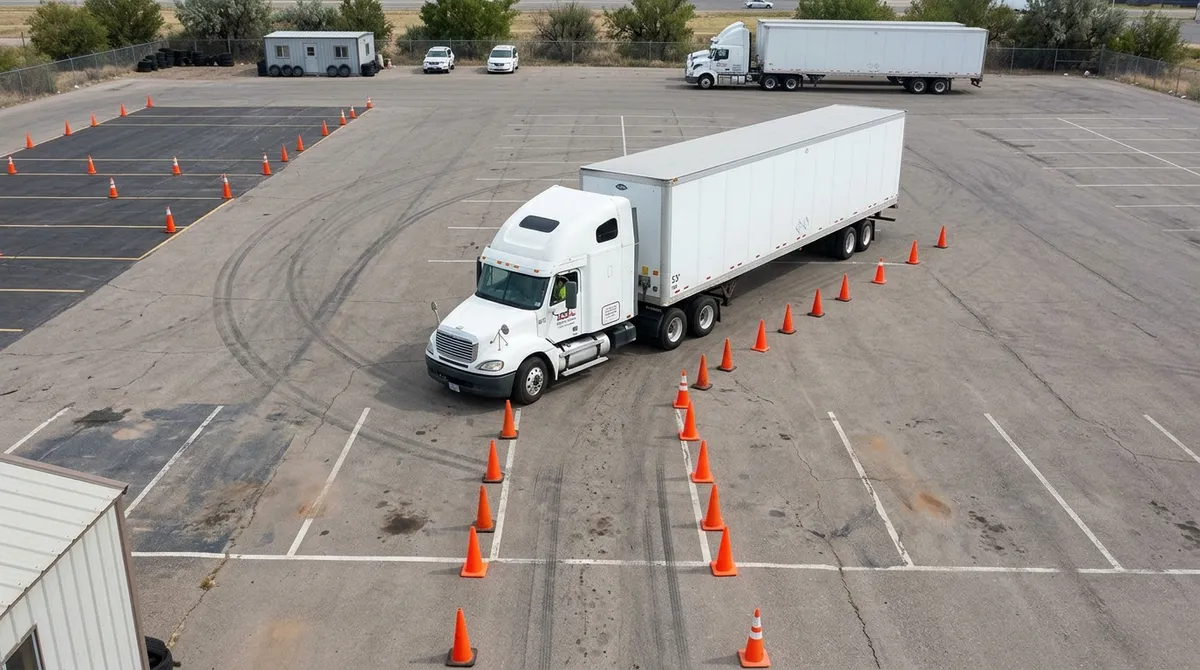
- Basic Controls / Backing: Maneuver the vehicle through a set course — straight-line backing, offset backing, parallel parking. These exercises happen in a lot, not on public roads.
- Road Test: Drive on actual roads under examiner observation. You'll be evaluated on lane changes, intersections, turns, highway merging, and overall situational awareness.
The pre-trip is where most people lose points — not because it's hard, but because they didn't memorize the sequence. Practice it out loud, repeatedly, until it's automatic. The backing exercises take more physical time to master. Get as many hours on the backing course as you can before test day.
If you fail one section, you typically only need to retest that section, not the full test. Fees for retesting vary by state.
How Much Does CDL Training Cost?
| Training Path | Upfront Cost | Total Cost | Employer Lock-In | Best For |
|---|---|---|---|---|
| Company-Sponsored | $0 | $0 (if you complete contract) $3K–$6K if you leave early |
6–12 months | No money to spend, okay with limited choice early on |
| Private CDL School | $3,000–$10,000 | Same + living expenses during training | None | Want freedom to pick any carrier from day one |
| Community College | $1,500–$5,000 | Same + longer timeline | None | Lower cost, flexible schedule, currently employed |
Some states offer CDL training grants or workforce development funding — especially for veterans and low-income applicants. Check your state's workforce development board before paying full tuition anywhere.
Company-Sponsored vs. Private School: The Real Tradeoff
This question comes up constantly, and the answer depends on your situation — not a universal ranking.
Company-sponsored makes sense if: you have no savings to cover training costs, you're comfortable spending 6–12 months with one carrier, and you're okay working for lower starting pay while you build experience. The risk is signing with a company whose culture, equipment, or routes you don't actually like. You find that out after the fact.
Private school makes sense if: you can cover the tuition (or finance it), you want to shop the job market with a clean license, or you already have a specific carrier in mind that doesn't sponsor training. You'll pay more upfront but negotiate from a stronger position when job hunting.
Here's what most people miss: the carrier you start with matters a lot. Not every company treats drivers the same. Equipment quality, home time, pay structure, and dispatch style vary enormously. If you're locked into a company-sponsored agreement, you can't walk out easily if it's not a good fit.
Before you sign any training contract — or any driving contract — read reviews from real drivers. See what people say about the home time, the equipment, and how dispatch treats you when things go sideways. That information exists. Use it.
→ Read: Trucking Company Red Flags to Watch Out ForReady to Find Your First Carrier?
Once you have your CDL, don't sign with the first company that calls. Read driver and public reviews, compare companies, and choose the carrier that actually fits your life — not just whoever's hiring.
Browse Carrier Reviews →What Happens After You Get Your CDL
The license is just the start. Here's what the first few months actually look like.
The FMCSA Drug & Alcohol Clearinghouse
Any employer who hires CDL drivers must register with the FMCSA Drug & Alcohol Clearinghouse and query it before putting you behind the wheel. You'll also need to register yourself as a driver. This is a federal database that tracks drug and alcohol violations. It's mandatory — not optional — and the query happens before your first day on the job.
You'll also need to pass a pre-employment drug screen (typically urine test) before any carrier puts you in a truck. Random testing continues throughout your career.
Endorsements
Beyond your base CDL, you can add endorsements that open up specific cargo or vehicle types:
- H — Hazardous Materials (requires background check and TSA approval)
- N — Tank Vehicles (liquid tankers)
- T — Double/Triple Trailers
- P — Passenger Transport
- X — Combo of H and N (tank + hazmat)
Hazmat and tanker endorsements pay better. Many experienced drivers add them within the first year to increase their options.
First Year Pay Expectations
Entry-level CDL-A drivers typically earn $45,000–$65,000 in their first year, depending on the carrier, route type, and freight. OTR (over-the-road) drivers earn more but are away from home more. Regional and local routes pay a bit less but allow for regular home time. By year two to three, $70,000–$90,000 is realistic with the right carrier and freight type.
Choosing Your First Carrier
New drivers often take whatever offer comes first. That's understandable — but it's worth spending a few days comparing options. Look at guaranteed miles, pay per mile vs. hourly vs. salary structure, home time policy, equipment age, and how drivers talk about the company online.
→ See our list: Best Trucking Companies to Work For in 2026FAQ
Yes. CDL training programs are designed for people with no prior commercial experience. You start with the basics — shifting, braking, mirrors — and work up to full maneuvers over the course of training.
CDLs are typically valid for 4–8 years depending on your state. You'll also need to renew your DOT Medical Certificate (up to every 2 years) and keep it on file with your CDL.
A DUI conviction can disqualify you for a set period. A first offense in a non-commercial vehicle typically results in a 1-year CDL disqualification if you're in the vehicle at the time with a BAC over 0.04%. A DUI in a commercial vehicle carries heavier penalties. After the disqualification period, many people do re-qualify — but carriers may still decline to hire based on their own policies.
It depends on weight. Vehicles over 26,001 lbs GVWR require at least a Class B CDL. Many box trucks used for local delivery are under that threshold and don't require a CDL. Check the vehicle's GVWR on the door placard to be sure.
A Commercial Learner's Permit allows you to practice driving a CMV with a licensed CDL holder in the passenger seat. It's required before you take your skills test. Once you pass the skills test, you exchange the CLP for the full CDL.
For most people: yes. The freight industry isn't slowing down and demand for CDL-A drivers remains consistent. Starting salaries are solid for a job that doesn't require a degree, and experienced drivers with clean records have a lot of negotiating power. The main risk is the first carrier you choose — which is why reading driver reviews matters before signing anything.
Don't Sign With the Wrong Carrier
You did the hard work. You passed the test. Now make sure the company you join is actually worth your time. Browse real driver reviews at Oculus Reviews before you commit.
Read Carrier Reviews →About the Author
CDL driver since 2016, owner-operator, fleet operator. Co-founder of Oculus Reviews.
Join Oculus Reviews Today
Create your free account and start building your professional trucking reputation.
Related Articles
Is CDL Scan Legal? What a Driver Can Do About a Bad Entry
What CDL Scan is, whether the FCRA applies to a site that calls itself a social network, and the five written steps that give a driver the best chance of getting a false entry corrected.
How to Report a Trucking Company That Won't Pay You
Who can make a carrier pay: DOL Wage and Hour, your state, FMCSA, OSHA or small claims, with every deadline and a demand letter. WHD recovered $259M in FY2025.
Trucking Wage Theft: 12 Ways Carriers Short Your Pay
12 ways carriers short driver pay, from HHG miles to escrow, and how to catch each one on your settlement. Detention alone costs drivers up to $1.3B a year.