What Is a CSA Score? A CDL Driver's Plain-English Guide
- CSA = Compliance, Safety, Accountability — an FMCSA program that scores carriers on safety performance.
- Scores go from 0–100. Higher is worse. Above certain thresholds, FMCSA steps in.
- Seven categories called BASICs cover everything from speeding to drug violations to brake failures.
- Carriers scores are public. Drivers don't have a public CSA score, but their history lives in a PSP record.
- A carrier's high CSA score can cost them loads, jack up insurance, and trigger federal audits.
If you've been driving for any length of time, you've probably heard a dispatcher, safety manager, or recruiter mention CSA scores. Maybe you're applying to a new carrier and they keep talking about their "BASIC numbers." Maybe someone warned you to avoid a certain company because their CSA is "through the roof."
But what does any of it actually mean for you — the driver behind the wheel?
This guide breaks it all down without the government-speak. By the end, you'll know what CSA scores are, how they're calculated, what happens when a carrier's scores get bad, and how to look one up yourself in about 60 seconds.
1. CSA Scores Explained Simply
CSA stands for Compliance, Safety, Accountability. It's a program run by the Federal Motor Carrier Safety Administration (FMCSA) — the federal agency responsible for regulating commercial trucking in the United States.
The program was designed to do one thing: give FMCSA a way to identify carriers (and, to a degree, drivers) who are operating unsafely — before a serious crash happens. Instead of waiting until an accident, FMCSA uses inspection data, violation records, and crash history to build a running score for every carrier operating under a DOT number.
Here's the part that trips people up: a higher score is worse, not better. Think of it less like a grade and more like a risk meter. A carrier with a CSA score of 80 in a key category is in serious trouble. A carrier sitting at 15 is doing fine.
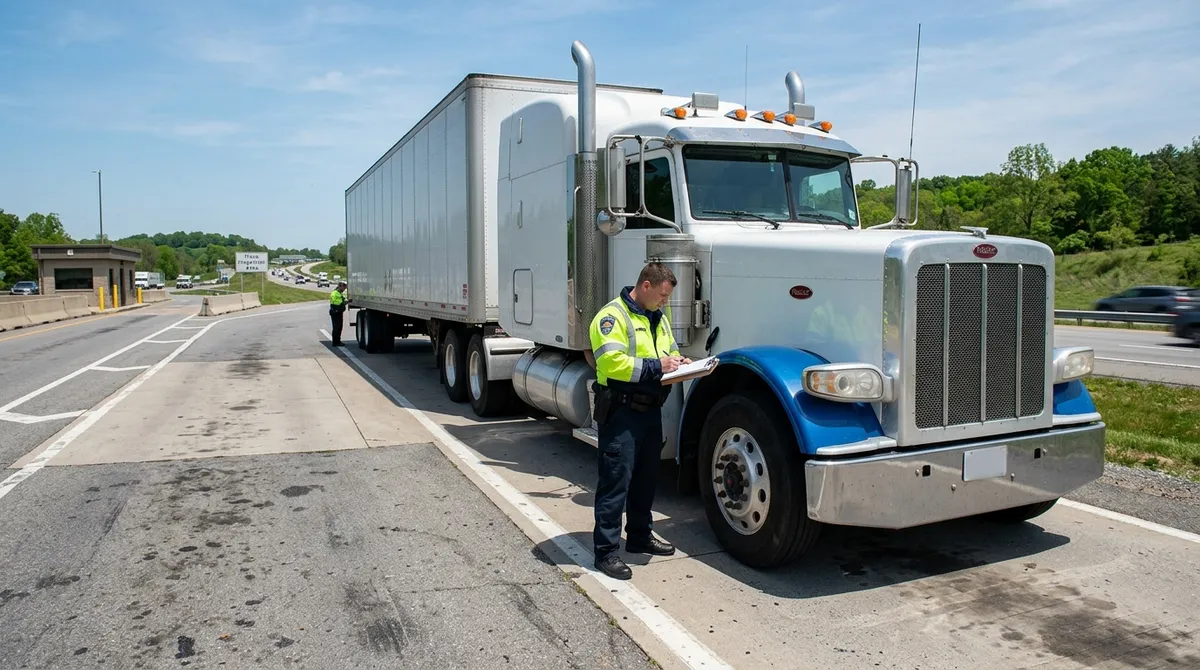
The data behind these scores comes from roadside inspections. Every time a driver gets pulled into a scale house or flagged for an inspection, the results go into the FMCSA database — and they count toward the carrier's CSA score for the next 24 months.
2. The 7 BASIC Categories Broken Down
FMCSA doesn't lump everything into one score. Instead, they break safety performance into seven categories called BASICs — short for Behavior Analysis and Safety Improvement Categories. Each BASIC gets its own score.
| BASIC Category | What It Covers | Intervention Threshold (Passenger/General) |
|---|---|---|
| Unsafe Driving | Speeding, reckless driving, improper lane changes, distracted driving | 65% / 65% |
| Hours-of-Service (HOS) Compliance | Logbook falsification, HOS violations, ELD issues, driving beyond limits | 65% / 65% |
| Driver Fitness | Invalid CDL, expired medical cert, operating without required endorsements | 80% / 80% |
| Controlled Substances & Alcohol | Drug/alcohol use or possession while operating a CMV | 80% / 80% |
| Vehicle Maintenance | Brake failures, tire defects, lights out, faulty equipment | 80% / 80% |
| Hazardous Materials (HM) Compliance | Improper placarding, leaks, packaging failures for hazmat loads | 80% / 80% |
| Crash Indicator | History of crashes — frequency and severity, not fault | 65% / 65% |
A few things to know about this list:
- Controlled Substances and HM Compliance aren't publicly visible on the FMCSA website in their full detail — FMCSA keeps those partially restricted. But they do factor into safety ratings and interventions.
- Crash Indicator doesn't require fault. If a carrier's trucks keep ending up in crashes — even crashes they didn't cause — the score goes up. This frustrates a lot of carriers, but FMCSA's position is that pattern matters.
- Not every carrier has every BASIC scored. If a carrier doesn't have enough inspection data in a category, FMCSA won't generate a score for it. You need a minimum number of inspections before a BASIC score appears.
3. How CSA Scores Are Calculated
The math behind CSA scores isn't public down to the last decimal, but the general framework is well-documented:
Step 1 — Inspections feed the system. Every roadside inspection creates a record. There are three main inspection levels that matter here:
- Level I (Full Inspection): The most thorough. Inspector checks both driver docs and the vehicle from top to bottom — brakes, tires, lights, fluids, cargo securement. Takes 45–60 minutes.
- Level II (Walk-Around): Driver docs plus a visual inspection of the truck without going underneath. More common at scale houses.
- Level III (Driver-Only): No vehicle inspection. Just CDL, medical cert, logbook/ELD, and basic credentials.
Step 2 — Violations get severity weights. Not all violations are equal. A brake-out-of-adjustment violation is weighted differently than a burned-out marker light. More serious violations carry higher point values.
Step 3 — Time matters. Recent violations count more than older ones. A violation from 6 months ago hits harder than the same violation from 22 months ago. This decay factor rewards carriers who clean up their act.
Step 4 — Carrier size is factored in. FMCSA knows a fleet running 200 trucks will have more inspections than a two-truck owner-operator. The scoring methodology accounts for this through percentile ranking — you're scored against other carriers of similar size and inspection frequency, not on an absolute scale.
Step 5 — The score lands between 0 and 100. The final score is a percentile rank. If your Unsafe Driving BASIC is at 70, that means 70% of comparable carriers have a better (lower) score than you. You're in the bottom 30% — and depending on the threshold, that may trigger intervention.
4. What the Scores Actually Mean (Thresholds)
A CSA score sitting at 45 in Vehicle Maintenance doesn't automatically mean anything bad happens. What matters is whether the score crosses FMCSA's intervention threshold for that BASIC.
When a carrier crosses the threshold:
- Warning letter — FMCSA sends a letter notifying the carrier of the elevated score and asking for corrective action.
- Targeted roadside inspections — The carrier's trucks get flagged in the inspection selection system. Inspectors at scale houses see them as high-priority.
- Offsite investigation — An FMCSA compliance specialist reviews the carrier's records remotely.
- Onsite investigation — An actual audit. FMCSA investigators show up at the carrier's terminal and go through everything.
- Cooperative Safety Plan — If things are bad but not catastrophic, FMCSA may put the carrier on a supervised improvement plan.
- Operations out-of-service (OOS) — The most severe outcome. FMCSA shuts the carrier down entirely.
Beyond federal action, there's a market layer on top of this. Many shippers and brokers have their own internal cutoffs — some won't work with carriers who score above 50 in Unsafe Driving or HOS, regardless of FMCSA's threshold. Insurance underwriters watch these scores closely too. One bad quarter in Vehicle Maintenance can push premiums up significantly at renewal.
5. How to Look Up a Carrier's CSA Score (Free, Public)
Step-by-Step: Look Up Any Carrier's CSA Score for Free
- Go to safer.fmcsa.dot.gov
- Click "Company Snapshot" in the top navigation
- Enter the carrier's USDOT number or company name, then hit Search
- On the carrier's snapshot page, click "SMS Results" (Safety Measurement System)
- You'll see all available BASIC scores, color-coded by severity:
- Red — above intervention threshold
- Yellow/Orange — approaching threshold
- Green/Gray — within normal range or insufficient data
- Click any BASIC to see the underlying inspection and violation details
You can also go directly to ai.fmcsa.dot.gov/SMS for the full Safety Measurement System dashboard.
The whole lookup takes under two minutes. If you're considering driving for a company, checking their CSA score before you sign anything takes less time than filling out the application. It's worth it.
6. How CSA Affects Drivers (The PSP Record)
Here's where a lot of drivers get confused: individual drivers don't have a public CSA score.
The CSA system is built around carrier DOT numbers. But that doesn't mean drivers are invisible. Every inspection and violation tied to a driver gets attached to two records:
- The carrier's CSA score — the public one we've been talking about
- The driver's PSP record — the Pre-Employment Screening Program record
The PSP record is a personal inspection and crash history that follows a driver from job to job. It goes back 5 years for crashes and 3 years for inspections. Carriers pay to pull PSP reports during hiring — it's one of the main tools recruiters use to vet drivers before making an offer.
The awkward part: you can't directly see how your violations affected a carrier's CSA score. You can pull your own PSP report at psp.fmcsa.dot.gov for a small fee, and that will show your inspection history and any violations recorded against you. But the internal weightings and how FMCSA ties your record to a specific BASIC score aren't visible to you directly.
What you can — and should — do:
- Pull your own PSP report at least once a year
- Check it for errors (wrong dates, violations that weren't yours, crashes you weren't in)
- If you find errors, file a DataQ challenge at dataqs.fmcsa.dot.gov — it's free and can get incorrect data removed
7. What Bad CSA Scores Mean for Drivers Working There
⚠️ Think Twice Before Driving for a High-Score Carrier
If a carrier's CSA scores are in the red — especially in Unsafe Driving, HOS, or Vehicle Maintenance — there are real consequences for you as a driver, not just them as a company.
Here's what actually happens when you drive for a carrier with elevated CSA scores:
You'll get inspected more
Carriers above intervention thresholds get flagged in the inspection selection system. That means their trucks — including yours — get pulled into scale houses more frequently. More inspections = more opportunities for violations on your PSP record, even if the issue is a maintenance problem that isn't your fault.
You may lose loads
Shippers and brokers check CSA scores. If a carrier's numbers are bad, freight dries up. Drivers at these carriers often deal with inconsistent miles, load cancellations, and dispatchers scrambling to find compliant lanes. Lean weeks aren't just frustrating — they affect your paycheck directly.
The company could get shut down
If a carrier receives an unsatisfactory safety rating or gets an out-of-service order from FMCSA, operations stop. That means you're suddenly without a job, possibly mid-lease on a truck, and scrambling to find a new carrier. It happens more than most drivers expect.
It reflects on your record
The inspections your truck goes through while you're employed there become part of your PSP. A carrier with poor Vehicle Maintenance will fail equipment inspections. Even though the brake adjustment isn't your job, the inspection record goes in your file. Future employers will see it.
Before signing with any carrier, take five minutes to check their CSA scores at safer.fmcsa.dot.gov and look at what other drivers are saying about them. You can cross-reference common trucking company red flags and use driver reviews to build a more complete picture of what it's actually like to work there.
Is Your Carrier's FMCSA Data Showing Risk?
Oculus Reviews pulls public FMCSA safety data alongside real driver reviews — so you can see the full picture before you commit to a carrier.
Check Your Carrier's Safety Data →8. FAQ
Can a driver see their own CSA score?
Not directly. Drivers don't have a public CSA score the way carriers do. What you do have is a PSP record — your personal inspection and crash history. You can pull it yourself at psp.fmcsa.dot.gov for a small fee. It shows inspections from the last 3 years and crashes from the last 5. Review it for errors and dispute anything inaccurate through the DataQ process.
How long do violations stay on a CSA record?
For scoring purposes, violations are weighted over a 24-month window. Older violations carry less weight as they age. The data itself is retained in the FMCSA system for up to 36 months. After 24 months, a violation no longer meaningfully affects a carrier's BASIC percentile score.
What CSA score is considered bad for a carrier?
Thresholds vary by BASIC category and carrier type. In general, scores above 65 in Unsafe Driving, HOS, or Crash Indicator are in intervention territory. Vehicle Maintenance and Driver Fitness thresholds sit around 80. Many commercial shippers apply stricter internal cutoffs — some won't work with any carrier above 50 in key BASICs.
Does a carrier's CSA score affect drivers personally?
Yes — in practical ways. High-scoring carriers get flagged for more roadside inspections, which means you'll get pulled over more. Any violations during those inspections go into your PSP record. If the carrier loses loads or gets shut down, you lose income. Working for a poorly managed carrier has downstream consequences on your professional record even when the underlying failures aren't yours.
Can a carrier dispute CSA violations?
Yes. Carriers — and drivers — can submit a DataQ challenge at dataqs.fmcsa.dot.gov to dispute inaccurate records. If the challenge succeeds, FMCSA corrects the record and the score recalculates. It's worth doing if you find errors, because even a single incorrectly recorded violation can push a score above a threshold.
Does CSA score affect my CDL directly?
CSA scores don't directly suspend or revoke a CDL — that's handled through state motor vehicle agencies based on traffic convictions. But serious violations that show up in CSA (like a Controlled Substances violation) often come with parallel CDL consequences through state processes. Your PSP record, which feeds from the same inspection data, is what employers actually see during hiring.
About the Author
CDL driver since 2016, owner-operator, fleet operator. Co-founder of Oculus Reviews.
Join Oculus Reviews Today
Create your free account and start building your professional trucking reputation.
Related Articles
Is CDL Scan Legal? What a Driver Can Do About a Bad Entry
What CDL Scan is, whether the FCRA applies to a site that calls itself a social network, and the five written steps that give a driver the best chance of getting a false entry corrected.
How to Report a Trucking Company That Won't Pay You
Who can make a carrier pay: DOL Wage and Hour, your state, FMCSA, OSHA or small claims, with every deadline and a demand letter. WHD recovered $259M in FY2025.
Trucking Wage Theft: 12 Ways Carriers Short Your Pay
12 ways carriers short driver pay, from HHG miles to escrow, and how to catch each one on your settlement. Detention alone costs drivers up to $1.3B a year.